これまでの研究成果
Previous research
ゼブラフィッシュ視細胞サブタイプのネットワークの同定
背景
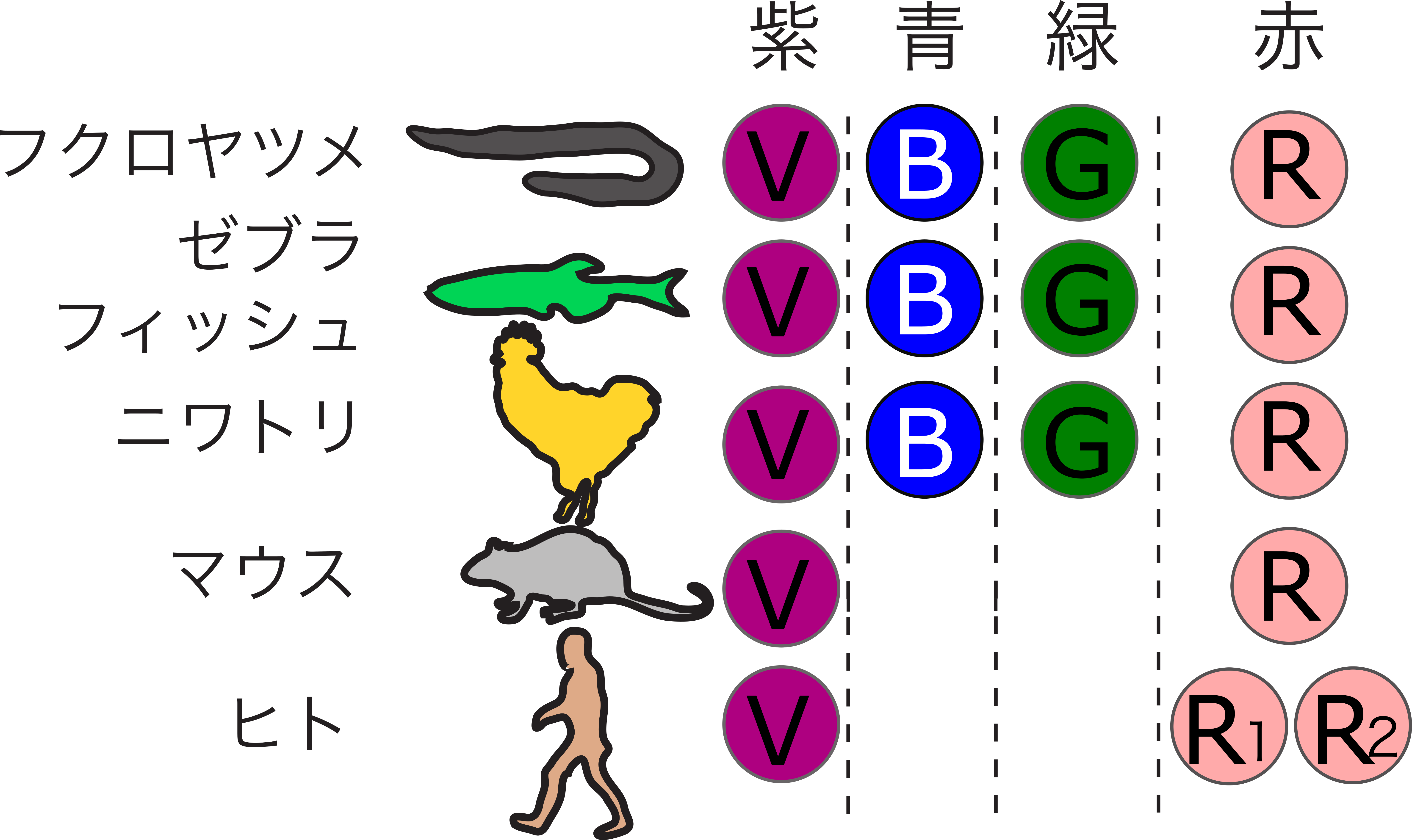
脊椎動物の視細胞は桿体と錐体の2種類に大別され、このうち、錐体は明るい場所での視覚を担う。さらに、異なる光波長に応答する錐体サブタイプを組み合わせることで、錐体は色覚を担う。脊椎動物が持つ錐体オプシン遺伝子の分子系統比較により、脊椎動物の祖先は紫・青・緑・赤の4種類の錐体オプシンを備え、4色型の色覚を原型とすると推定された。その一方で、哺乳類は青と緑の錐体オプシンを進化の過程で失っている。このため、マウスやヒト等の哺乳類モデルを用いた従来の研究では、青や緑色感受性の錐体サブタイプの生理的な意義に迫ることはできず、またこれら錐体サブタイプに備わる遺伝子発現メカニズムも全くわかっていなかった。
研究成果
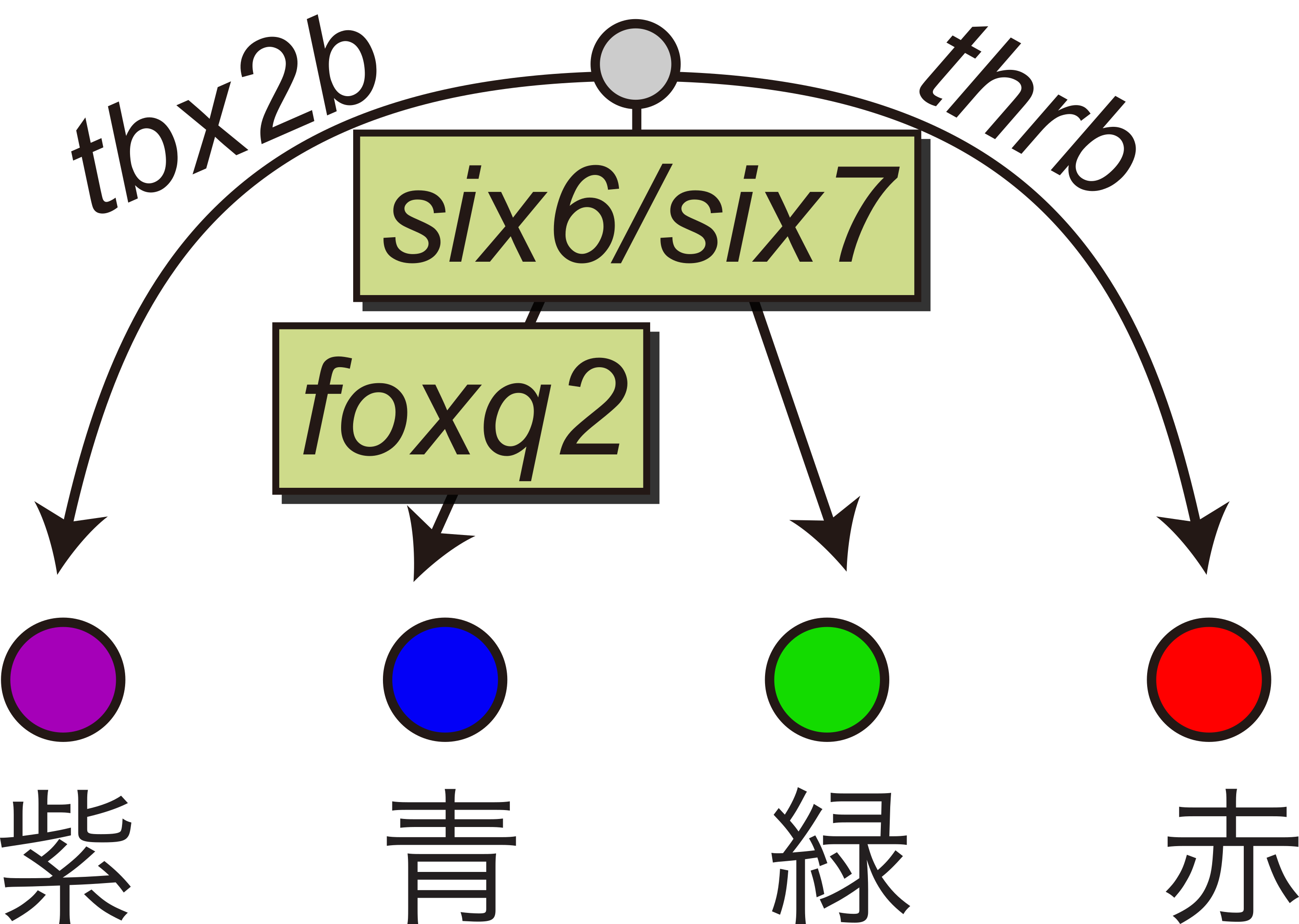
私たちは、4種類の錐体サブタイプを備えるゼブラフィッシュにおいて、錐体の発生や分化に寄与する候補因子の機能解析を、遺伝子改変技術を用いて行った。その結果、青錐体と緑錐体それぞれのアイデンティティを規定する転写因子カスケードが明らかとなった(図2)(論文1、 論文2、論文3)。さらに、得られた視覚変異体の摂餌行動を解析し、中波長領域感受性の錐体サブタイプの生物学的意義を明らかにした(ビデオ)(論文)。
脊椎動物の系統はそれぞれの進化の過程において、錐体細胞サブタイプのレパートリを変化させて光環境に適応してきました。たとえば、哺乳類への進化の過程においては、中波長領域感受性の錐体サブタイプを進化の過程で消失しています(図1)。このように、進化の過程における細胞レパートリの増減を可能にする分子メカニズムの一例として、転写調節ネットワークの変化を見出しています。ゼブラフィッシュにおいて中波長領域感受性の錐体サブタイプの分化に必須の転写因子SIX7とFOXQ2は、哺乳類ゲノムにおいてその遺伝子が失われています。その一方、紫外と赤に感受性の錐体サブタイプを規定する転写因子(TBX2とTHRB)はゼブラフィッシュと哺乳類で共通です(日本語総説)。これらの結果から、転写因子が織りなす転写調節ネットワークを種間比較することにより、生物種を越えて細胞タイプの相同性が見出されると考えています。
ビデオ ゼブラフィッシュ幼生の餌取り行動を変異体と野生型で比較した
変異体(TKO)と野生型コントロール(WT)の行動を比較した。白い点はそれぞれゾウリムシを示す。ゾウリムシを捕食した数を左上に示している。詳しくは論文1を参照してください。
裏話
学部生の頃からポスドク初期まで行った思い出深いテーマです。逆遺伝学的に遺伝子の探索を行う難しさを痛感しました。また、非哺乳類で見出した分子的な知見を哺乳類にて再検証するテーマはある程度ハイインパクトな研究として成立するものの、その逆の哺乳類の知見を非哺乳類へと適応するテーマは、論文のインパクトが非常に落ちてしまうというアンバランスさが身に染みました。
プロジェクトが終わって振り返ってみると、哺乳類で失われた遺伝子が、哺乳類では備わっていないシステム(青と緑感受性の錐体サブタイプの分化制御)を担うことが明らかになり、進化の過程で自然選択が生じたと強く示唆されました。比較分子生物学においては、それぞれの生物に備わる独自のシステムの解析は重要です。しかしながらさらに加えて、哺乳類と非哺乳類システムを比較して、より一般的な知識へと昇華させる必要があると実感しました。
Identification of Zebrafish Photoreceptor Subtype Networks
Media Reports
- Optometry Today.「Zebrafish provide insight into development of colour vision
- Phys.org「Colorblind fish reveal how vision evolved」
- Mirage News「Colorblind fish show experts how vision evolved」
- Technology Networks「Colorblind FIsh Reveal the Evolution of Vision」
Background
Vertebrate photoreceptors are broadly classified into rods and cones, with cones responsible for vision in bright environments. Furthermore, by combining cone subtypes that respond to different wavelengths of light, cones are responsible for color vision. Molecular phylogenetic comparisons of vertebrate cone opsin genes suggest that the ancestor of vertebrates had four types of cone opsins: violet, blue, green, and red, with tetrachromatic color vision as the prototype. On the other hand, mammals have lost blue and green cone opsins during evolution. Therefore, conventional studies using mammalian models such as mice and humans could not approach the physiological significance of blue and green-sensitive cone subtypes, nor did they understand the gene expression mechanisms of these cone subtypes.
Results
We performed functional analysis of candidate factors contributing to the development and differentiation of cones in zebrafish, which have four types of cone subtypes, using gene modification techniques. As a result, we elucidated the transcription factor cascades that define the identity of blue and green cones, respectively (Figure 2) (Paper 1, Paper 2, Paper 3). Furthermore, we analyzed the feeding behavior of the obtained visual mutants and clarified the biological significance of the mid-wavelength-sensitive cone subtypes (Video) (Paper).
The lineages of vertebrates have adapted to their light environments by changing the repertoire of cone cell subtypes during evolution. For example, during the evolution of mammals, mid-wavelength-sensitive cone subtypes have been lost (Figure 1). As an example of the molecular mechanisms that enable the increase and decrease of cell repertoires during evolution, we have found changes in transcriptional regulatory networks. The transcription factors SIX7 and FOXQ2, essential for the differentiation of mid-wavelength-sensitive cone subtypes in zebrafish, are lost in mammalian genomes. On the other hand, the transcription factors (TBX2 and THRB) that delineate the UV- and red-sensitive cone subtypes are analogous in zebrafish and mammals (see my review paper in Japanese for further details). In light of these findings, I believe that by comparing transcription regulatory networks involving transcription factors across species, one can identify homologies in cell types across species.
Video: Comparison of prey capture behavior between mutant and wild-type zebrafish larvae
Comparison of behavior between mutants (TKO) and wild-type controls (WT). The white dots represent paramecia. The number of paramecia captured is shown in the upper left. For details, refer to Paper 1.
Behind the Scenes
This is a memorable theme that I worked on from my undergraduate days to the early postdoc period. I keenly felt the difficulty of exploring genes in a reverse genetic manner. Moreover, while themes that revalidate molecular findings discovered in non-mammals in mammals can be established as relatively high-impact research, the reverse theme of applying mammalian findings to non-mammals significantly reduces the impact of the paper, which I felt keenly.
Looking back after the project ended, it became clear that genes lost in mammals are responsible for systems not present in mammals (control of differentiation of blue and green-sensitive cone subtypes), strongly suggesting natural selection during mammalian evolution. In comparative molecular biology, it is important to analyze the unique systems that each organism has. However, I realized that it is necessary to compare mammalian and non-mammalian systems and elevate them to more general knowledge.